Play Escoba Online
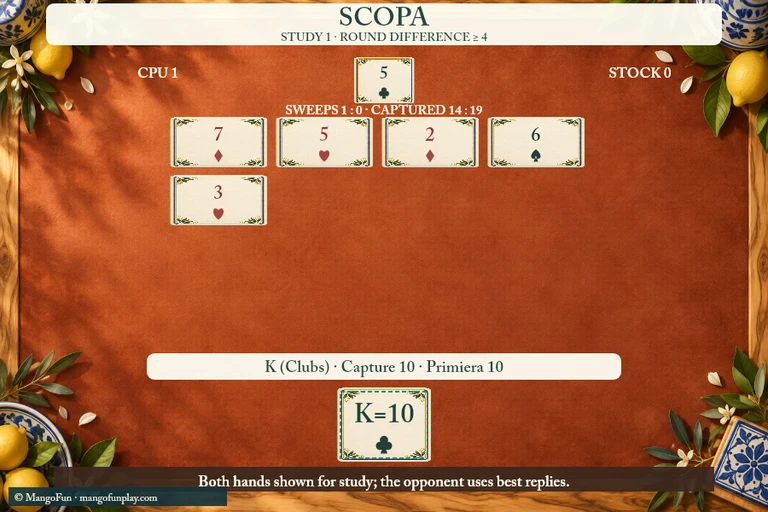
Two captures can make fifteen and still lead to different scores. Play the Escoba card game at a garden table with illustrated Spanish cards, then compare the choices in twenty original endgame studies. Escoba also includes complete matches against the computer. Play free online with no ads, download or account.
How to play Escoba online
- Choose a numbered endgame study or a complete match against the computer.
- Select one hand card and a table subset whose values add to fifteen together.
- Confirm the capture, or leave a card on the table when that chosen card has no capture.
- In a study, reach the displayed final round difference. In a full match, keep playing rounds until one side has at least fifteen points and a lead.
Controls
Tap a card in your hand, then toggle cards on the table. The preview adds their capture values; Play card confirms your choice. Next capture cycles through legal subsets. Arrow keys move focus, Enter selects, Space or P plays, ] cycles captures, H gives a study hint, U undoes a turn and C starts the next round. Score & cards pauses the game for inspection.
A tip before you start
Count categories as well as cards. Taking the seven of Coins or changing a tied majority can matter more than collecting the largest pile. Check what remains on the table before confirming a capture.
Escoba card game rules for this edition
Escoba uses a two-player, fifteen-point profile. Each of the four suits—Coins, Cups, Swords and Batons—has Ace through Seven, Sota, Caballo and Rey. Their capture values are one through seven, eight, nine and ten. The illustrated cards print these capture values directly, so Sota shows 8 even though a traditional Spanish deck labels that court card 10. There are forty cards and no eights or nines as separate numbered ranks.
Deal three, place four, then make fifteen
The dealer gives each player three cards and places four face up on the table. The non-dealer plays first. If the four opening table cards total fifteen or thirty, the dealer takes them immediately for one or two sweep points; no replacement table cards are dealt. Otherwise they stay in place. Whenever both hands run out, each player receives three more cards from the stock. Six packets and thirty-six plays complete a round.
Choose among every legal capture
Play one hand card with any one subset of table cards that brings the combined value to fifteen. For example, a Five can take a Rey worth ten, or an Ace and a Caballo worth one and nine. Neither choice has automatic priority. If the card you choose can capture, you must take one legal subset. You may instead choose a different hand card with no capture and leave it on the table. Invalid selections are rejected before any card moves.
Sweeps and the final table
A capture that empties the table earns one sweep point. The table then stays empty until a card is played onto it; it is not topped up from the stock. After the last hand card is played, the last player who made a capture receives the remaining table cards. That final collection does not earn a sweep. It can still change the majority categories, so the last capture is worth planning for.
Count five sources of round points
Score one point for each sweep and one point for capturing the seven of Coins. Three more categories award points for the most captured cards, the most Coins and the most Sevens. In this edition, a tied majority gives both players one point. Score & cards shows the captured counts and the points they produce. There is no weighted primiera category and no extra bonus for taking every Coin, every Seven or leaving the opponent very few cards.
Twenty original endgames with exact goals
Studies begin after legal play from a complete forty-card deal, with the stock empty and both remaining hands visible. Your goal is to guarantee at least the displayed final round point difference against the best legal replies. A target of zero means avoid losing the round; it does not mean win an entire match. Every target-preserving alternative is accepted. Early studies use one card per hand, while later studies involve up to three cards and more outcome-changing choices. The positions and their alternatives were checked independently.
Compare a choice, then undo the whole turn
Each study offers two exact hints. A hint selects a move that preserves the target when one remains available; it does not automatically play the card. Undo restores your last play and every subsequent reply, refill and scoring change. Used hints stay spent. Full matches also allow Undo for practice. Next capture lets you compare subsets before committing, and the sum preview makes it clear which cards you have selected.
Play a full match with hidden hands
Complete matches keep the opponent's hand and the stock hidden. The computer uses its own hand and public information to choose immediate captures; it does not claim expert play. Add round points to the match totals and alternate dealers. The match ends after a round when one player has at least fifteen points and a lead. Equal totals continue, even at fifteen or more. Restart repeats the original starting deal after confirmation; New deal begins a fresh match.
Know the profile and keep your place
Escoba editions differ in match targets, tied categories, optional discards and bonus scoring. This edition uses Ludoteka's classical fifteen-point category profile and the chosen-card capture obligation described by Pagat. It does not include Renuncio penalties, cash stakes, online rooms or a primiera variant. Pause, Help, Score and backgrounding suspend the computer. When local storage is available, study unlocks, sound and the exact legal match history resume. Failed artwork loads, invalid saves and unavailable storage show recovery notices.
Frequently asked questions
Can I play the Escoba card game online for free?
Yes. Escoba runs in your browser with no ads, download or account. Choose twenty original endgame studies or a complete match against the computer.
What are the basic Escoba card game rules?
Play one hand card and capture a subset of table cards that adds to fifteen with it. In this edition, a chosen card that can capture must do so. Sweeps and captured-card categories score points; full matches play to at least fifteen with a lead.
What are Sota, Caballo and Rey worth?
Their capture values are eight, nine and ten. Escoba prints these values directly on the court cards to make the fifteen-sum preview easier to read.
What happens when a majority category is tied?
Both players receive one point for that tied category. This applies to captured cards, Coins and Sevens in this edition; other Escoba profiles may score ties differently.
Does the last player always take the leftover cards?
No. The last player who made a capture receives the leftover table cards, without a sweep bonus. That may be different from the player who played last.
Does a completed study mean I won the match?
No. A study tests its displayed final round point difference with both hands revealed. Complete matches are separate, hide the other hand and continue across rounds toward fifteen points.
Can I undo or resume a match?
Yes. Undo restores your last play and the following replies and score changes. Study hints remain used. Valid progress and legal histories resume through local storage when it is available.
About Escoba
Two captures can make fifteen and still lead to different scores. Play the Escoba card game at a garden table with illustrated Spanish cards, then compare the choices in twenty original endgame studies. Escoba also includes complete matches against the computer. Play free online with no ads, download or account.
Play this puzzle / casual game in the embedded browser player. No app installation or MangoFun account is required. Follow the instructions shown inside the game; controls and device support depend on the title.